
Home › NHL Realignment Project
NHL Realignment Project Week 37: A 32-Team Map
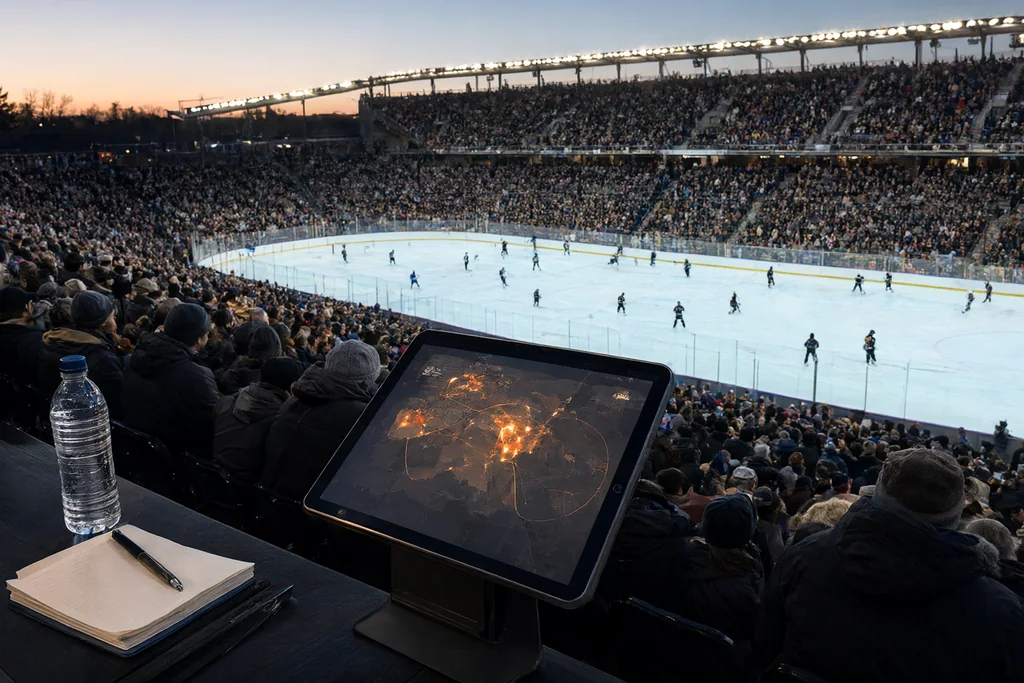
This week we are adding four new teams to the map west of the Gretzky-Orr line, two via expansion and two via relocation.
Four New Teams Out West
Just to make sure the eastern side of the map does not feel completely neglected, we have allowed another relocation to stay within the Orr Conference. The Pacific Northwest has a love of hockey that is untapped and the MLS is showing us that the Vancouver/Seattle/Portland corridor has great fans that love great rivalries with their neighbors.
Houston and KC round out the central part of our map and Quebec gets the team they deserve. I also threw Columbus a bone, and let them keep their team this week.
Two Conferences, Two Divisions, 32 Teams
We are going with a two conferences of two divisions each format. Again, the conferences are named for Gretzky and Orr while the division names are our old favorites: Patrick, Adams, Norris and Smythe. Eight teams in each division giving us a total of 32 teams.
The cities in play this week, across expansion and relocation:
- Seattle
- Portland
- Kansas City
- Houston
- Quebec City
Geography and Travel
Like last week, every team has to travel to Canada for divisional games. Every division is stretched vertically, the two easternmost a little less, but still very stretchy, so that is reasonably equal as well. Nobody can whine about travel leaving them at a massive disadvantage.
Once again, north-south is the way. Divisional games may necessitate long trips, but staying within your time zone or only having to travel one over makes all the difference for player fatigue and for TV ratings.
Rivalries and Heritage
Though we lose CHI/DET, we do get TOR/DET. Not bad. The NYR/NJD, the Alberta teams, Pennsylvania teams, and BOS/MTL all stay together too, so check that off your list. New teams give us great rivalries too: SEA/POR/VAN, DAL/HOU, KC/STL.
The division names are awesome. Hockey is special, and now the conference and division names reflect that.
The 90-Game Schedule
| Slice | Games |
|---|---|
| Divisional, three home and three away against seven teams | 42 |
| Non-divisional, one home and one away against 24 teams | 48 |
| Total | 90 |
Playoff Seeding
Top three from each division qualify, plus the next two best records from the conference as wildcards. Division Champs are seeded 1 and 2 based on record. All other qualifiers are seeded 3-8 based on record, so yes, a wildcard can have a higher seed than a top-three qualifier.
This keeps the regular season more interesting and division focused, as finishing top three is the first ticket into the playoffs. Wildcard is just a backdoor option to keep things a little fair for fourth and fifth placed teams in a division having a super-stacked-with-awesomeness year.
Once qualification happens, division centric, other than division champions getting 1 and 2, it is all about your record for seeding, conference centric. This way we are more likely to avoid a two-best-teams-meeting-too-early-in-the-playoffs scenario.
Do not forget to share our lil' project with your hockey fan friends. And, as always, thanks for reading. Until next Sunday.
Read next
What Realignment Means for a League and Its Fans
Moving teams between conferences and divisions looks like a map exercise, but the promise and the cost land on rivalries, travel and the playoff path.
Conferences and Divisions: How They Shape a Season
Grouping decides the schedule, the playoff path and how often rivals meet. What conferences and divisions actually control, and why fans argue about them.
Travel, Time Zones and the NHL Schedule Debate
Distance is the easy part. Time zones change the body clock, which is why a genuinely fair schedule is harder to build than it looks on a map.