
What a Goaltender Actually Does: Roles and Habits
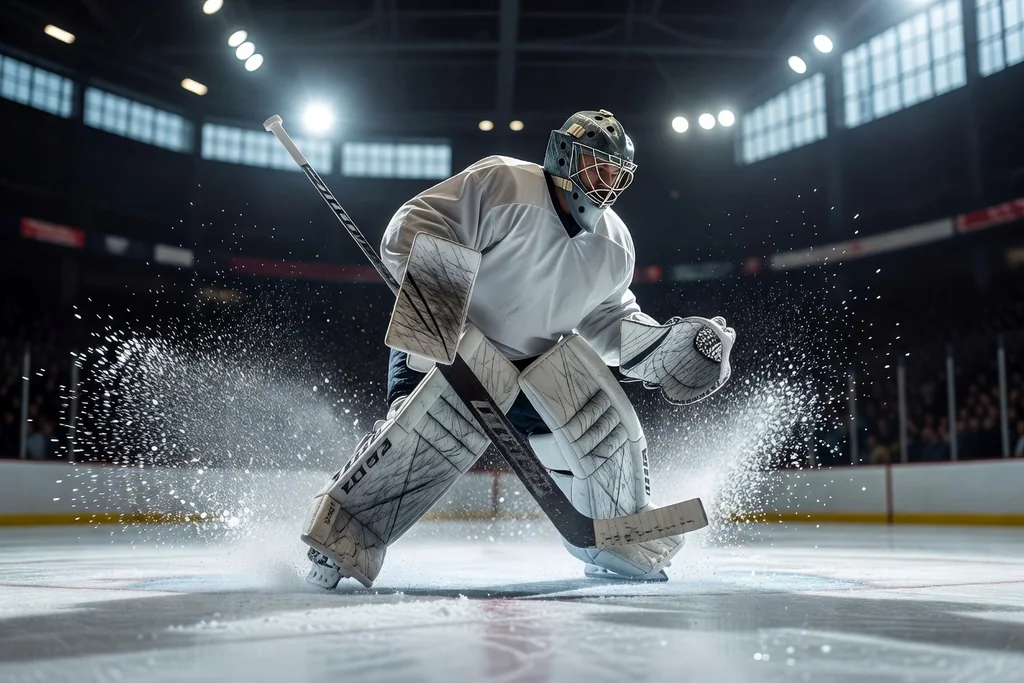
Goaltending is the most visible position in hockey and one of the least understood. The saves get the attention, but the job is mostly about things that happen before the puck arrives: reading the play, holding position and giving the team a predictable last line.
This piece looks at what a goaltender is actually doing over the course of a game.
Positioning before reflexes
The single biggest factor in stopping a puck is being in the right place when it is released. A goaltender who has read the play correctly often makes a difficult save look routine, because the movement required has already been reduced by good positioning. Conversely, a spectacular save is often the result of an earlier error that made the spectacular necessary.
This is why coaches talk about angles and depth rather than about reaction speed. The reflex is the last resort, not the plan.
Reading the play, not the puck
Elite goaltenders spend most of a game watching things other than the puck: stick positions, body angles, where teammates are, how a shooter is approaching. The puck is the conclusion of a sequence, and a goaltender who only watches the conclusion arrives late. The skill is essentially pattern recognition built over thousands of repetitions.
The routine that holds a game together
Goaltending is a job of long stretches of low activity punctuated by seconds of maximum intensity. That rhythm is brutal on concentration, so most goaltenders build routines: how they prepare between whistles, how they reset after a goal, how they handle a long delay. The routine is not superstition; it is a way of returning the mind to the same starting point over and over.
What a goaltender is responsible for
| Task | Description | Visibility |
|---|---|---|
| Stopping shots | The obvious part of the job | Very high |
| Rebound control | Directing pucks away from danger | Low |
| Playing the puck | Starting breakouts and supporting defenders | Medium |
| Communication | Telling the group what is coming | Very low |
Signs a goaltender is playing well
- Rebounds land in safe places rather than in the slot.
- Movement looks economical rather than frantic.
- The defence appears calm, because it knows what the last line will do.
- Fewer odd-man situations develop from pucks played poorly behind the net.
How a coaching staff thinks
Coaches rarely talk about outcomes. They talk about process: entries, exits, support, spacing, and whether the group is doing the same thing at the same time. That language can sound like evasion when you want a straight answer about a loss, but it is the only vocabulary that predicts anything. A team that plays the right way and loses is, most weeks, in a better place than a team that plays badly and wins.
Roles, not labels
Calling a player a first-liner or a checker describes where he starts a shift, not what he can do. Modern rosters blur those lines: a defensive forward who kills penalties may also be trusted with the last minute of a one-goal game, and a scorer may be asked to win a board battle rather than take a shot. Reading a lineup by role — who takes key faceoffs, who starts in the defensive zone, who is on the ice when the game is tight — tells you more than any depth chart.
The map behind the schedule
Every schedule is a compromise. Someone has to fly the long legs, someone gets the back-to-back games, and someone plays the road trip that ends in a different time zone three nights running. When fans argue about fairness, they are usually arguing about which compromise is acceptable, not whether one exists. Understanding that the calendar is a negotiated document rather than a natural object makes the annual complaints far easier to follow.
What travel really costs
Travel does not simply make players tired; it takes away practice. A long trip means days spent in transit and hotel rooms instead of on the ice, which slows the installation of any new system. That is why teams guard their practice time so fiercely and why a heavy road stretch can leave a mark that lasts well after the trip ends. The cost is measured in repetitions lost, not just in hours slept.
Rivalries are built by repetition
A rivalry is rarely created by a single incident. It grows out of meeting the same opponent often enough that the games acquire history — the same matchups, the same grudges, the same crowd. That is why grouping teams geographically tends to produce better rivalries than any marketing campaign, and why a well-designed structure is really an argument about who should see whom, and how often.
Reading a box score honestly
A box score tells you what happened, not why. Shots, hits and minutes are records of events, and events without context can mislead badly: a team can be outplayed and still win, or dominate and lose. Used well, the numbers are a set of questions. Used badly, they become a verdict. The discipline is to treat every line as the beginning of an inquiry rather than the end of one.
The value of a slow build
Building a team is slower than fans would like and faster than it sometimes looks. Prospects need years, systems need months, and chemistry needs game after game of shared experience. Any plan that assumes instant results is really a plan to churn through people. The organisations that last are the ones willing to accept a boring middle — a season or two of being unremarkable while the foundation sets.
The best compliment a goaltender can receive is that the game looked quiet. It usually means the work was done early, and the drama never had to happen.
Read next
How an NHL Season Is Structured
Preseason, regular season, trade deadline and playoffs: what each part is for.
Reading the NHL Standings Without Getting Lost
Points, games in hand, tie-breakers and why a table can be misleading in October.
Special Teams Explained: Power Play and Penalty Kill
What changes when a player sits in the box and why units are built differently.