
Watching-Party Games That Do Not Ruin the Game
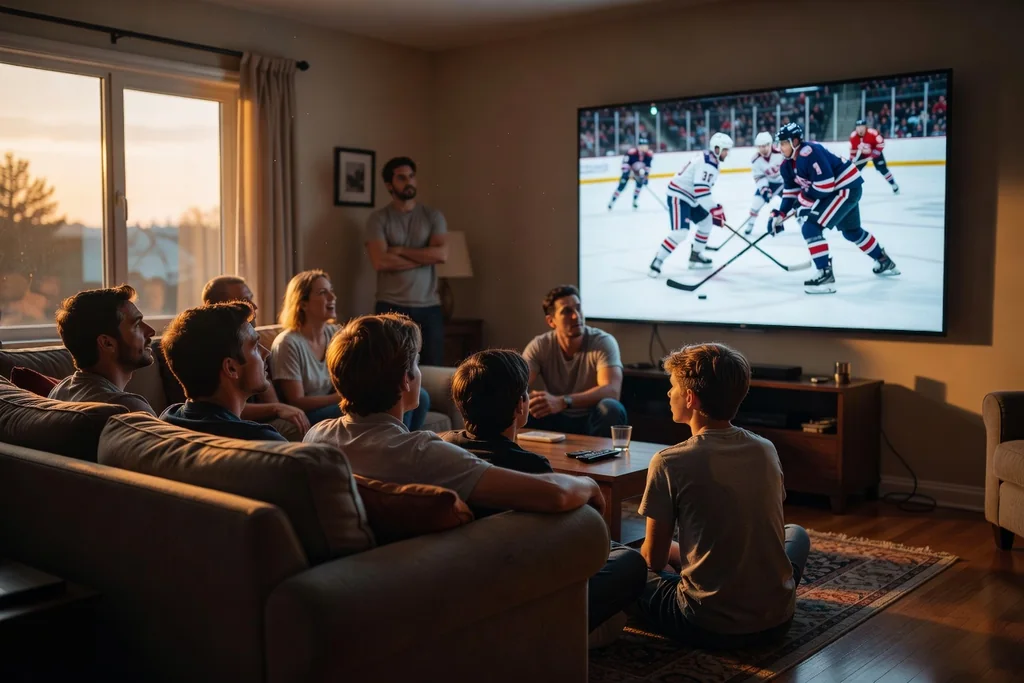
A game on television and a room full of people are a difficult combination. Somebody talks over the play, somebody checks a phone, and by the third period half the room is arguing about something that happened in the first. A small side game fixes most of this.
This article is about side games that add to a broadcast rather than competing with it.
The rule that matters
A good side game must be quiet and fast. Anything that requires discussion during play is a distraction; anything that can be settled between whistles is an enhancement. The broadcast is the main event, and the game exists to make people watch it more closely.
Simple formats
Each viewer picks a player beforehand and scores points based on observable events: a shot, a clean pass, a blocked shot, a shift won. The events are easy to spot and impossible to fake, which keeps the game honest without making it complicated.
Making it accessible
Guests who do not follow hockey should still be able to win. Choose events that are obvious to anyone: possession, a save, a shot on goal. A rule set that excludes the casual viewer will shrink the room within one game.
Formats worth trying
| Game | Rule in one line |
|---|---|
| Pick a player | Score for their positive actions |
| Period winner | Guess which team wins each period |
| Event bingo | Mark a grid as things happen |
| Silence clause | Lose a point for talking over play |
House rules that keep the peace
- Agree the scoring before the puck drops.
- No mid-game rule changes, however creative.
- Keep the stakes symbolic — nothing that makes a loss sting.
- Let the quietest person in the room choose the tie-breaker.
Reading a box score honestly
A box score tells you what happened, not why. Shots, hits and minutes are records of events, and events without context can mislead badly: a team can be outplayed and still win, or dominate and lose. Used well, the numbers are a set of questions. Used badly, they become a verdict. The discipline is to treat every line as the beginning of an inquiry rather than the end of one.
The value of a slow build
Building a team is slower than fans would like and faster than it sometimes looks. Prospects need years, systems need months, and chemistry needs game after game of shared experience. Any plan that assumes instant results is really a plan to churn through people. The organisations that last are the ones willing to accept a boring middle — a season or two of being unremarkable while the foundation sets.
Where opinions are strongest
The loudest arguments in hockey are usually about things nobody can measure cleanly: effort, leadership, toughness, who deserves credit. That is not a reason to avoid them, but it is a reason to hold them lightly. When a debate has no referee, the useful move is to state your assumptions out loud. Half of every hockey argument evaporates the moment both sides say what they are taking for granted.
The fan's job description
Being a fan is not a passive state. It involves choosing sources, deciding what to care about, and resisting the urge to treat every rumour as a promise. The supporters who enjoy the sport most tend to be the ones with a short list of things they follow closely and a long list of things they happily ignore. Attention is the scarce resource in a long season, and spending it deliberately is a skill.
Structure beats inspiration
A single brilliant shift can win a game, but it cannot win a month. What survives a long season is structure: the habits a group falls back on when it is tired, the shape it keeps when the game gets chaotic, the decisions that are made automatically because they have been rehearsed hundreds of times. Inspiration is the fun part. Structure is the part that is still there in March.
What changed and what did not
Hockey has changed a great deal in how it is played and surprisingly little in what it rewards. Speed matters more, space is defended differently and goaltending is a profession of its own, but the underlying currencies — possession, territory, patience and the ability to win the moments that decide games — have been stable for a very long time. Noticing the constants is as useful as tracking the fashions.
Disagreement as a feature
The best hockey writing is written by people who disagree with each other. A league with one correct opinion would be a dull league, and a journal with one voice would be a pamphlet. Arguments about style, structure and value are not noise around the sport; they are the sport, carried on in words between the games. Reading widely is the only way to hear more than one of them.
The long view
Hockey looks different depending on how far back you stand. From a single game, everything is dramatic. From a season, patterns emerge. From a decade, the fashions become visible: how systems arrived, spread, and were answered. Choosing the right distance is most of what makes an argument either useful or merely loud, and it is a choice the reader can always make.
Practice, patience and the honest assessment
Anyone who has watched a rebuilding team knows the uncomfortable middle: too good to be rewarded with the best picks, too thin to make a run. The temptation is to force a decision — trade for now or sell for later. The honest assessment is usually to wait, keep the process clean, and refuse to let a bad month rewrite a good plan. That is much harder to sell to a fanbase than a headline, which is exactly why it is worth writing about.
The point of a side game is not to produce a winner. It is to give everyone in the room a reason to look up at the same moment.
Read next
Hockey Trivia: How to Build a Good Quiz
Fair questions, sensible difficulty and a scoring rule nobody argues about.
Polls and Fan Debates: Why Everyone Argues
What a poll can and cannot tell you about a fanbase.
Nickname Guessing Games for Hockey Fans
A simple party format that works even with casual viewers.